The American State You’re Not Visiting (But Should Be)

“Nothing Could Be Finer Than To Be in Carolina In The Morning”
Yes, there’s no Times Square bravado, no Californian gloss, no Floridian theme-park spectacle. But having been visiting for the past twelve years, I would agree entirely with Gus Kahn’s words from a century ago.
North Carolina doesn’t need any of this to be the most complete, most authentic and, for my 10 cents’ worth, one of the most compelling states in the whole US. It’s also a place in recovery. If you’ve recall seeing it on TV, it was most likely in late 2024, when Hurricane Helene tore through parts of western North Carolina, particularly around Asheville and the iconic Blue Ridge Parkway. Roads washed out, trails closed, small businesses took a blow that many places wouldn’t get back up from.
But Carolinians are built different.
Visit now and you’ll find most of the state open again, with a noticeable sense of resilience: breweries pouring, trails reopening, general stores trading as they have for generations. Tourism here are a vital part of an economy rising from devastation and all you may have heard about southern hospitality applies here in spades.
For British travellers mapping out a first U.S. trip, North Carolina rarely makes the shortlist.
It should, as it packs the very best bits of America into a landmass no larger than England. Here are my recommendations for the ultimate roadtrip to The Tar Heel State.
Getting there from the UK

Direct flights from London to Charlotte (via American Airlines and British Airways) take around eight to nine hours, making it one of the more accessible entry points to the American South. A daily flight also goes to Raleigh-Durham, equidistant between mountains and coast. From either airport, pick up a rental car and choose your own adventure.
Other hubs include Washington (5hrs’ drive to Raleigh) and Atlanta (3hrs’ drive to Charlotte).
If you’re within the US, regional flights service both cities, as well as Asheville (for beer) and Wilmington (for beaches).
If you like the Rockies…head to the Blue Ridge Mountains

Western North Carolina is where the Appalachian range becomes something quietly spectacular. The Blue Ridge Parkway, conceived during the New Deal in the 1930s as a public works project, runs for 469 miles, linking national parks and threading through ridgelines with every turn-off eliciting a gasp…and a scramble for the camera.
This is one of the great American roadtrips, with the section from Asheville to Boone a favourite amongst travellers. If I’ve learnt one thing from my time on the parkway, it’s to
Near Boone, the landscape softens into a sequence of pull-offs and short trails. Price Lake offers an easy loop walk with mirror-like reflections; the Linn Cove Viaduct, completed in 1987, curves around Grandfather Mountain in a feat of engineering that avoids disturbing the fragile ecosystem below.
Pull-offs (with ample parking) from the highway occur nearly every mile - truthfully, picking your spot for a picnic or a stroll is the challenge. Hiking trails are well-marked, access is straightforward, and towns like Boone and Blowing Rock sit conveniently nearby. Even post-Helene, much of this area has reopened, though it’s worth checking local conditions, repairs are ongoing in places, and your visit directly supports recovery.
One aside: if you’re coming late in the evening, keep an eye out for the resident black bears…one of my all-time heart-in-mouth moments. Suffice to say, take all food waste with you and, if you come across one, walk backwards away slowly!
If you like Napa or Sonoma…head to the Yadkin Valley

North Carolina’s wine industry is younger than California’s, but not without pedigree. The state has the oldest record of grape-growing in North America and was one of the US’ biggest wine producers in the 19th century before Prohibition dismantled the industry.
Today, the Yadkin Valley has re-emerged as its focal point. The geography, rolling hills, moderate elevation, supports a range of varietals, particularly those suited to Rhône-style wines. Jones von Drehle Vineyards & Winery, established in 2007, encapsulates this style. Tastings are relaxed – the Cab Franc a highlight – and the setting spectacular in the foothills of the Appalachians. Come in summer for live music performances on the outdoor stage, together with pairings with local produce. As Diana Jones, the co-owner states, “What grows together, goes together.”
If your abiding thought remains “I’ve never even heard of North Carolina wine,” try Jones von Drehle’s Twyst and Twyne. This signature white blend beat out their storied California rivals to win gold at the San Francisco Wine Festival in blind taste tests.
If you like the East Coast beer scene… head to Asheville (and beyond)

Asheville has become shorthand for craft beer in the American Southeast. With more breweries per capita than anywhere else in the country, it has the credentials without losing its heart. This is where Helene hit hardest with the fact that any breweries along the riverfront are even trading, let alone thriving, is testament to the downright stubbornness of brewers and the deep-set community.
At Burial Beer Co, expect a rotating list of IPAs and stouts served beneath murals that lean heavily into the gothic. New Belgium, down by the river, helped pioneer the region’s now-thriving sour beer scene and with nods to all manner of beer styles and flavours. Both are open and operating, part of a wider effort to bring visitors back after Helene’s disruption.
Asheville may be beer city but anywhere you go in NC will hit the spot. In Boone, Appalachian Mountain Brewery pairs its beers with live bluegrass and a collegiate crowd. Tap Station in Apex has taken over an old gas station to create a spectacular three-storey brews and dining experience. Basically wherever you head across the state, you’ll meet not only great beers.
There are now over 400 breweries across North Carolina, offering not only great beer but a host of local knowledge – they’ve become the community hubs that British pubs used to be.
If you like American sporting theatre…head to Tobacco Road

College sport in America requires a double take for most Europeans. These are students – how can they attract the level of passion and devotion reserved solely for pro athletes anywhere else on the planet?
To see this writ large, there’s no better place to head than Tobacco Road. Named after the previous principle industry, this 7-mile corridor connects University of North Carolina (UNC) at Chapel Hill, Duke University, and North Carolina State University. These institutions sit within a short drive of each other, but culturally they occupy very different worlds.
The Duke – UNC basketball rivalry is the centrepiece: a contest steeped in decades of tension, legendary coaches, and games decided in the final seconds. There are no pro basketball teams in this part of the state, allowing the college game to become embedded in a way it never quite has elsewhere. The reputation of both universities also helps, although writing as Duke graduate, there’s only one correct answer on who you should support.
You’ll never get tickets unless you want to part with $1,000+ but watching any game (the season runs November to March, culminating in the nationwide March Madness tournament) is equivalent to any football derby in Europe.
In the professional ranks, this region (also known as The Triangle) delivers too. The Carolina Hurricanes are consistently one of the best teams in the National Hockey League and for anyone hankering after some late 80s Kevin Costner nostalgia, catch a game at the Durham Bulls (yep, the real life team from Bull Durham)
If you like Chicago…head to Charlotte

Charlotte is often treated as a gateway, somewhere you fly into before heading elsewhere. That’s a mistake.
Historically a gold rush town, the first in the United States, following a 1799 discovery nearby, Charlotte evolved into a banking powerhouse, now second only to New York in the U.S. financial sector. Great for the local economy, less so as a tourism advertisement….BUT it’s one of the most underrated city breaks stateside and if you’re an NFL fan, the skyscrapers make for a great backdrop for a Carolina Panthers game at Bank of America Stadium.
Uptown (Charlotte’s city centre) is compact and walkable, with museums such as the Levine Museum of the New South offering context on the region’s post–Civil War transformation…plus the NASCAR Hall of Fame for those who prefer their culture to be a bit more petrol-driven.
South End, once industrial, is now lined with galleries, breweries (Wooden Robot is as fun as its name suggests), and the city’s light rail running straight through it. Once you’ve eaten and drunk, the Fourth Ward is a surprisingly historic and leafy area to stroll…before succumbing to temptation and disappearing into an inviting café or bar and repeating the cycle.
Like Chicago, Charlotte balances a cool centre with unexpected attractions within its distinct neighbourhoods. It’s the sort of manageable, culturally engaged city break that European travellers often favour before heading to the mountains, less than a 2hr drive away.
If you like Texas barbecue…head to Lexington

Barbecue in North Carolina is not a style - it’s an argument, described once as ‘the third rail of Carolina politics’.
The roots go back centuries, to early colonial cooking methods and the influence of German and Scots-Irish settlers. This isn’t unique in the US but today, the state is divided into two camps. Eastern-style barbecue uses the whole hog, chopped finely and dressed with a vinegar and red pepper sauce, sharp, acidic, simple. Western focuses on pork shoulder with a slightly sweeter, tomato-tinged sauce.
Neither is a bad choice but the single biggest centre is Lexington, which gives its name to the Western style.
Lexington BBQ (serving since 1962) remains the benchmark for the western style. Sam Jones BBQ offers a more contemporary take while preserving traditional methods. Elsewhere, just follow the signs – the more ‘frozen-in-time’ somewhere looks, the better the meal.
What’s striking is how localised the debate remains. Unlike Texas barbecue, which has been exported and reinterpreted globally, North Carolina’s version is still largely consumed where it originates – “Carolina-style BBQ” in the UK would draw confused looks without specifying if its East or West. Whichever way you swing, you’re in for a feast.
If you like the idea of being transported back to the 1920s… head to General Stores of Western NC
In western North Carolina, the general store remains just that – a treasure trove of hardwear, souvenirs and snacks often standing in the centre of the community it serves.
The Mast General Store, established in 1883, operates much as it always has: wooden floors, barrels of loose goods and mix of practical supplies and unexpected curiosities. During the Great Depression, it famously accepted barter instead of cash, reinforcing its role as a community anchor. Don’t try that now unless you want a hard stare.
These stores persist because they’re still useful. Yes they cater to tourists – I could shamelessly spent all day here – but locals still drop in for essentials, linger on the shop porches and exchange news. Even better some also have their own BBQ joints attached.
If you like Cape Cod… try the Outer Banks
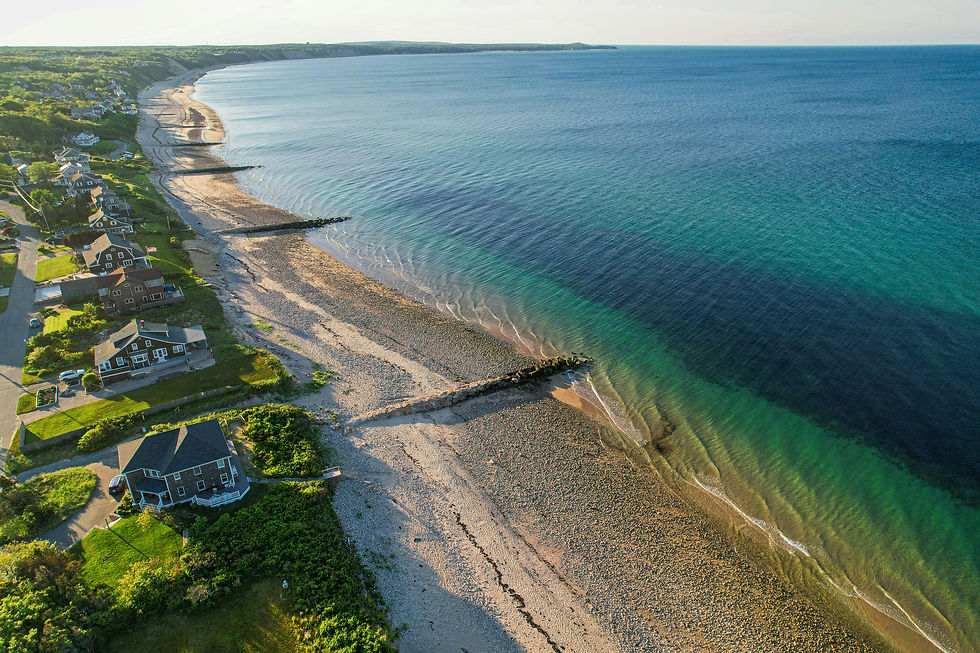
Stretching along the Atlantic, the Outer Banks feel geographically - and psychologically -distinct from the mainland. You probably already guessed that from the Netflix show.
This is where, in 1903, Orville Wright and Wilbur Wright achieved the first powered flight at Kitty Hawk, a moment that reshaped the modern world. Today, the site is marked but not kitsch, a rarity for landmark American locations – or, it has to be said, large swathes of the US coastline.
Elsewhere, Cape Hatteras Lighthouse stands as a reminder of the coast’s long maritime history, while the dunes at Jockey’s Ridge form the tallest natural sand dune system in the eastern United States.
The appeal lies in its restraint. Development is limited by law, the landscape shifts constantly, and long stretches of beach remain largely empty, making it ideal for those who love the coast but can take-or-leave crowded beach resorts.
Article By Phil Thomas
Phil Thomas is a travel journalist based in Cambridge, UK. You can follow his adventures on his blog Someone Else’s Country and on Instagram (@exploresomeoneelsescountry)


