Late Transmissions: New Album - A Collaboration of 3 Friends
- May 11
- 11 min read
Updated: May 13

Behind Late Transmissions are David Balfe and David Hughes – two friends who last played together in the Merseyside post-punk scene. Balfe, playing with Big In Japan and The Teardrop Explodes, went on to be a producer, publisher and founder of both Zoo Records and Food Records, signing Blur and Echo & The Bunnymen among many others.
On 1st May 2026 the two friends released their brand new album, THE HEART WANTS WHAT IT WANTS which sees them team up with Eve Quartermain, and sees Late Transmissions exploring fresh new territory.
With the record continuing to build momentum, we had the pleasure of sitting down with Late Transmissions' very own David Balfe to find out more.
How are you, Dave?
I'm very well, thank you. It's a lovely time of year—it always lifts the spirits.
There's lots to talk about, but to begin, how has 2026 treated you so far?
That's a big question! Honestly, I've struggled with a bad shoulder, though I doubt your readers are too interested in that. Thankfully, it's cleared up completely. But as I was saying, it's amazing how things turn around. Every year, I find the early months a bit gloomy with all the darkness. Then, I'm always pleasantly surprised by how much spring brightens my mood.

And what better way to celebrate spring than with a new LP?
Absolutely. We've been working on this for years. At first, we took a relaxed approach as I reconnected with an old friend. Dave Hughes and I became friends and bandmates as teenagers—he was 17, and I was 18 when we first met. We’ve stayed friends and kept in touch over the years.
After playing in various bands in his early twenties, Dave moved into TV and film soundtrack work. I’d always admired his skills—he started out writing orchestral arrangements and working with real orchestras, but as budgets inevitably tightened, he developed an impressive ability to create convincing orchestral sounds with his own equipment.
I was always impressed by what he could do. At some point, I suggested we try making the kind of music I love—what I call 'orchestral pop.' Artists like Scott Walker, Dusty Springfield, John Barry, and Shirley Bassey inspired us, especially from the era before electric guitars, drum machines, and synthesizers became dominant.
As much as I enjoy all those elements—and much of my career has involved them—I’ve always found orchestras the most moving. There’s something uniquely emotional and theatrical about them. So I proposed that we explore this orchestral style together, and we began to experiment. We were genuinely pleased with the results. I tend to be overly self-critical, often doubting the quality of my own work.
But with this project, I truly thought, "Wow, this sounds great." For a couple of years, we worked casually, bouncing ideas back and forth, developing the music and enjoying the process. Eventually, we realized we had some strong songs and needed a great singer. After much searching, we found Eve Quartermain, based in Liverpool and a friend of a friend of Dave’s.
She was everything we dreamed of for our songs. Her voice is extraordinary—powerful, magnificent, and yet beautifully vulnerable, with a touch of tragedy. She embodies all the qualities we admired in singers like Shirley Bassey and Dusty Springfield.
You’ve already offered a taste of the album with the track "I'm Done With London." How has the response been so far?
It’s been really positive. Back when I was more actively in the music business, you’d send your work to music papers and radio stations. Now, you release it online and it reaches thousands of publications and countless listeners. I’ve been very pleased with the reaction. The album has received five-star reviews and enthusiastic praise. We’ve also released a couple more tracks, testing the waters as we go.
We made videos for "Lightning Never Strikes Twice" and "The Heart Wants What It Wants" last year—I’m not sure if you’ve seen them yet. We really just wanted to see what sort of reaction we’d get, and since the response was so encouraging, we decided to move ahead and release the full album—which is what we’re doing now.
When you are making the music videos, especially, how do you think it adds another dimension?
We always envisioned the project in cinematic, almost theatrical terms. One of my main goals for the songs was to create what I call 'story songs.' Whether it's "Eleanor Rigby," "She's Leaving Home," "Wichita Lineman," or "Downtown," I believe a song doesn't need an elaborate narrative, but it should evoke something more than vague, artsy lyrics—it should feel like a real story.
Wanting to capture that feel, we aimed for a cinematic quality in our videos. For "I'm Done With London," we ultimately chose a minimalist approach. For those unfamiliar with the song, it's told from the perspective of a woman reflecting on her time in London—how she fell in with the wrong crowd, became a party girl, and after years of being used and partying, ended up living a damaged, lonely life in pubs.
So, we created a video that simply features her in a pub, telling her story. We didn’t have the budget for a full cinematic production, but I like to think you could make an entire film from the song. In fact, the film "Darling" with Julie Christie and Dirk Bogarde was in the back of my mind while writing it. I don't know if you remember that from the 60s. That was kind of in the back of my mind while we were writing it. But also, you know, Eve got involved in sort of generating the inspiration for the song.
Eve has had a rich and varied life, full of ups and downs, and that really influenced our work together. We rewrote many lyrics after she joined, inspired by her unique spirit, energy, and life experiences—which we felt added authenticity whenever the stories reflected aspects of her journey. So everything became closely interwoven. While the songs aren’t strictly autobiographical, they’re all inspired by the kinds of experiences Eve has had.

When you reflect on music and your personal connection to it, was there a particular piece that instantly made you feel that human connection?
For me, Scott Walker stands out above all. I’m not sure how familiar you are with his work, but he’s truly fantastic. I was introduced to Scott Walker years ago, back when I was in The Teardrop Explodes, by our singer Julian Cope.
At first, I didn’t like it—I thought it sounded like Frank Sinatra or Rat Pack-style music. But then I realized it was much stranger, darker, and more artistic, reminiscent of black-and-white French or Swedish films from the 1960s. In fact, one of his most famous songs, "The Seventh Seal," is inspired by an Ingmar Bergman film. I remember listening to Scott Walker’s music in the dark, in bed—it felt like watching a film. His songs tell stories and are incredibly evocative and emotional. I could name so many: "Montague Terrace in Blue," "Such a Small Love," "Big Louise," "Jackie"—not hundreds, but certainly dozens of fantastic solo songs.
I’d highly recommend giving his music a listen.
On the theme of storytelling—what, in your view, are the key elements of a strong story?
That’s a big question. I actually took a creative writing course over 20 years ago, then completed an MA in screenwriting, and spent a lot of time studying the craft. I never managed to get a script made, which is quite difficult, but it taught me a lot about storytelling. Ultimately, a good story needs a protagonist striving for something—whether they succeed or fail, there’s an element of triumph or tragedy.
Afterward, we came up with a phrase to describe our music: 'tragic romantic.' It’s about love gone wrong—it might end in heartbreak or even something darker. Interestingly, though, some of our love stories actually end happily. But the common thread is love not going as planned.

The LP comes out on the 1st of May when the LP comes out. What is on your to-do list?
I have a very long to-do list—and honestly, it's quite dull.
There are all these little tasks to handle. Back in the day—when I started putting out records as both a musician and a manager in the late '70s and mainly through the '80s—there were only a couple dozen things that needed doing. You dreamed of getting on Radio One, or featured in the music papers—which were just three or four at the time. That was about it, so there wasn’t much to stress about.
Now, there are thousands of things to manage. You’re expected to be on social media daily, posting updates about every little thing—every review, every breakfast, everything. I still haven’t quite adjusted to that pace.
Unfortunately, Eve isn’t keen on social media either. I think it takes a certain personality—perhaps a younger, more uninhibited one—to share every aspect of life online. People share breakups, makeups—sometimes their entire life story. That’s just how things are today.
So, we focus on other ways to connect—making videos, sharing news, and coordinating those efforts as best we can. I have to admit, it doesn’t come naturally to us. Before social media, there was a certain fun in the mystery—fans learned everything at live shows. It’s a very different world now.
With our old-fashioned sensibilities, it’s hard to adjust to this new era of constant sharing. I have nothing against it in principle—it’s just not my cup of tea. And I suspect it’s not most people’s cup of tea. But there are those who love it—the influencers and pop stars who thrive on social media.
Of course, many successful pop stars have people following them, taking photos as they enter and leave buildings, restaurants, studios—posting everything so their fans stay updated. I was a huge David Bowie fan myself. Back then, I’d be lucky to see one new picture of him a month. Now, if you follow an artist, you might see ten photos a day—the mystery has disappeared. But it’s become a requirement now. If you’re a new artist, you have to do it.
If you’re already a superstar, maybe you can pull back a little. But if you want to get noticed, that’s the game. Honestly, I’m not sure we’re doing enough. We keep meaning to do more, but we just never quite get around to it.
Thinking about the relationship between yourself, the three of you, what is it that you admire about your unity as a collective?
Actually, things are coming together more now. I was up in Liverpool last Thursday, and we did a photo session and an interview for The Guardian. That was the first time we’d all come together for something like this. Since they’re based in Merseyside and I’m on the South Coast, most of our work happens over Zoom, email, or phone calls. When I was in bands years ago, we were often together too much—endless time in studios, hotels, touring—which sometimes led to friction just from being in each other’s pockets.
So this time, it genuinely felt like we were a band. We’d met up before and had meetings, but this was different. I really enjoyed it. I think we all felt that way. It’s a strange aspect of the modern world—people can collaborate from opposite ends of the country or even the world, thanks to technology. That just wasn’t possible when I started out. You had to get into a room to make music together.
What do you think you bring out eachother’s strengths?
Everyone’s very sensitive to each other’s strengths. When Eve joined, we were slightly nervous, even though we believed the music was strong.
At that stage, we hadn’t written all the songs—just six or seven. She loved them, which gave us confidence, and we loved what she brought to the tracks. From there, we began tailoring the songs to suit her sensibilities and character. In my experience, musical chemistry can be tricky—many great bands have split because of it.
Dave and I have a complementary dynamic—he’s strong where I’m not, and vice versa. That balance works really well together. And Eve is a fantastic singer, while Dave and I aren’t particularly strong vocalists ourselves. That helps a lot, and it seems to be working well at the moment—even if it’s always a bit unpredictable. Making music together is a bit like being in a relationship—sometimes it’s like dating or even marriage. Things might be good now, but you never know how they’ll evolve.
With this body of work that you're about to release, what has it taught you about your, I guess, your versatility as artists?
As for versatility, I’m not sure. The album is certainly diverse, though.
On one level, it’s consistent: orchestral and dramatic throughout. It’s all slightly cinematic, but there’s a lot of variety within that style. At one point, we worried it might be too diverse—and I’m still not entirely sure it isn’t. But I think diversity is a strength. Some people want an album to sound consistent throughout, while others prefer a collection with a range of styles. We certainly have versatility in that sense. Lately, I’ve wondered what direction our second album might take—more of the same, or a new approach? I’ve always been a big conceptualist.
I enjoy coming up with concepts—this project started as cinematic orchestral pop, no electric guitars, no synths. But what really works is letting things evolve and grow organically, rather than forcing a direction. That’s what happened here, and I’m a big believer in letting things develop naturally—instead of suddenly deciding, for example, that the next album should sound like Kraftwerk.
So talking about the album artwork then, what made you, how did you decide what image would be the perfect calling card?
We took a lot of photos and wanted something that felt a bit timeless. Our music has echoes of the '40s, '50s, '60s, and even some '90s trip-hop influences—like in "Lightning Never Strikes Twice." That sense of timelessness was important to us. That’s why we liked the image we chose—it looks like it could be from the '40s, '50s, '60s, or today. We also loved the typography that Marcus designed. It reminded me of an old jazz album, but still feels appealing for the 21st century.
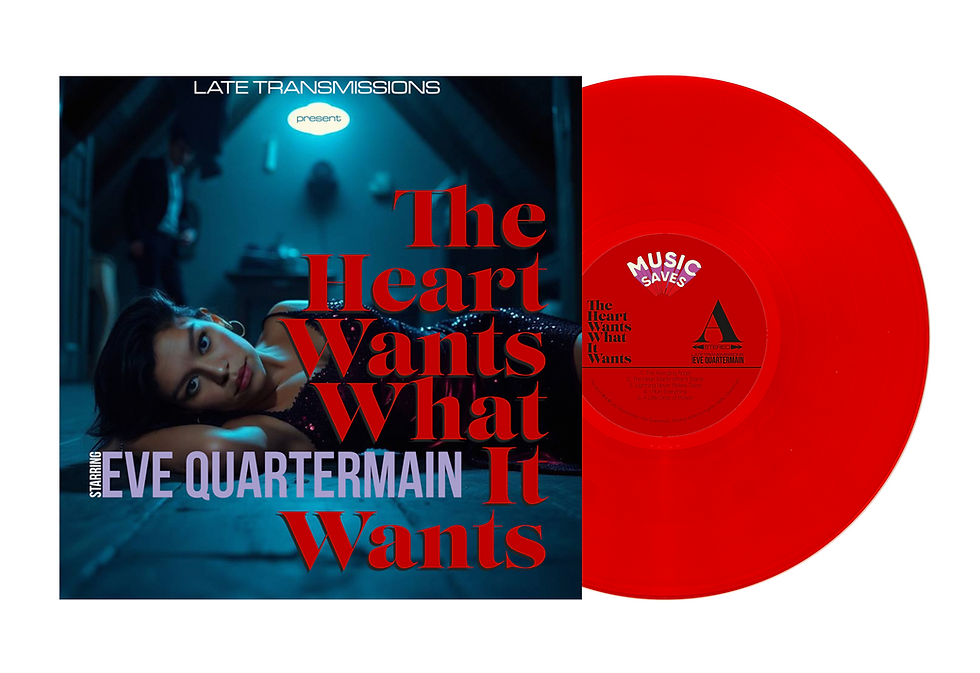
And for those who get the physical release, there’s the beautiful red vinyl too.
The red color just emerged naturally—and it happens to be my favorite. It naturally became the background color for the album sleeve. Years ago, producing colored vinyl was much more expensive than it is now. Now, colored vinyl is the norm. It really does look gorgeous when you take it out of the sleeve and see it match the background.
Well, Dave, it's been fantastic speaking to you. When the record comes out officially on the 1st, what are you doing to celebrate?
I haven't got anything planned. Honestly, I’ll just feel relieved. I like to think I’ve been around the block a few times—life’s brought both excitement and its share of letdowns, disappointments, and successes.
I thought I was too old for nerves like this, but I have to admit—I’m a bit tense. So, relief will be the main feeling. We’re not expecting a number one album or anything like that—we just wanted to release it. We’re very proud of it and think it’s something special.
The reviews have been positive—some even call it ‘brilliant,’ if I’m allowed to say so! That feels like a success in itself. These days, it’s difficult to stand out in the flood of new music, but it seems we’re making some kind of impact. That’s a success in itself. The challenge is that, whenever you reach a milestone, it’s tempting to want even more. It’s hard to know what truly counts as success. But yes, I’m a bit tense, so I just want to get it out and relax for a while.
Well, I wish you all the best. And I hope you get plenty of relaxation, too.
The brand new album, THE HEART WANTS WHAT IT WANTS is available now.
FACEBOOK facebook.com/latetransmissions
MUSIC SAVES www.musicsaves.co.uk

Article By Thushara Chandrasiri


