Where Cliffs Meet Calm: A Coastal Escape Through Pembrokeshire’s Wild South
- Dec 17, 2025
- 5 min read

There are few coastlines in Britain that feel as alive as Pembrokeshire’s. The air carries the scent of salt and gorse, the cliffs hum with seabird song, and around every bend of the coastal path lies another view that stops you in your tracks. It is a place where rugged nature and quiet luxury coexist, where each day can end with the soft hiss of the tide and begin with the whisper of waves on ancient rock.
Our journey unfolded slowly, starting with a stay at the St Brides Spa Hotel, perched high above Saundersfoot Bay. It’s not merely a hotel,it’s a refuge for the soul. From the moment we stepped into the lobby, with its sweeping glass façade overlooking the sea, we knew we had arrived somewhere special. The décor was a study in calm: driftwood tones, Welsh slate, gentle sea greens. Our room was undoubtedly the best in the house, it felt suspended between sky and water. Floor-to-ceiling windows opened onto a balcony where gulls glided level with the horizon.
The St Brides Spa is its own world of serenity. The infinity hydrotherapy pool, fed by saltwater, seems to spill straight into the bay below. We lingered there each evening, watching the light shift from gold to rose to indigo, the sea a living canvas beneath us. Inside, the aroma of seaweed oils filled the air as we drifted between steam rooms and saunas. The spa treatments drew on the sea’s natural bounty, using local marine ingredients: kelp, sea salt, and lavender harvested from Pembrokeshire’s coastal gardens. It was a place to exhale completely.

Each morning, after a breakfast of a couple of coffees, local eggs, and warm Welsh cakes, we set out to explore the coastline. The Pembrokeshire Coast Path, which hugs the edge of the county like a ribbon, offered us our route and our rhythm.
Our first stop was Church Door Cove, near Manorbier: a place that looks as though it belongs in a fantasy novel. The cove takes its name from a colossal natural archway carved by centuries of waves, its silhouette resembling the pointed arch of a Gothic cathedral. Descending the steep, grassy path, we reached a small beach hemmed in by cliffs streaked with green algae. The view here is breathtaking.
Just around the headland lies Skrinkle Haven Beach, a secluded crescent of golden sand accessible by a winding path through bracken and wildflowers. Here, the cliffs rise high and enclosing, offering both shelter and drama. The sea, a vivid blue-green, invited us to paddle as the waves folded softly over the sand. In summer, the air carries the scent of salt and sea thrift; in autumn, the wind sings through the rocks. Every tide redraws the beach, leaving behind patterns of rippled sand and tide pools glinting with life.
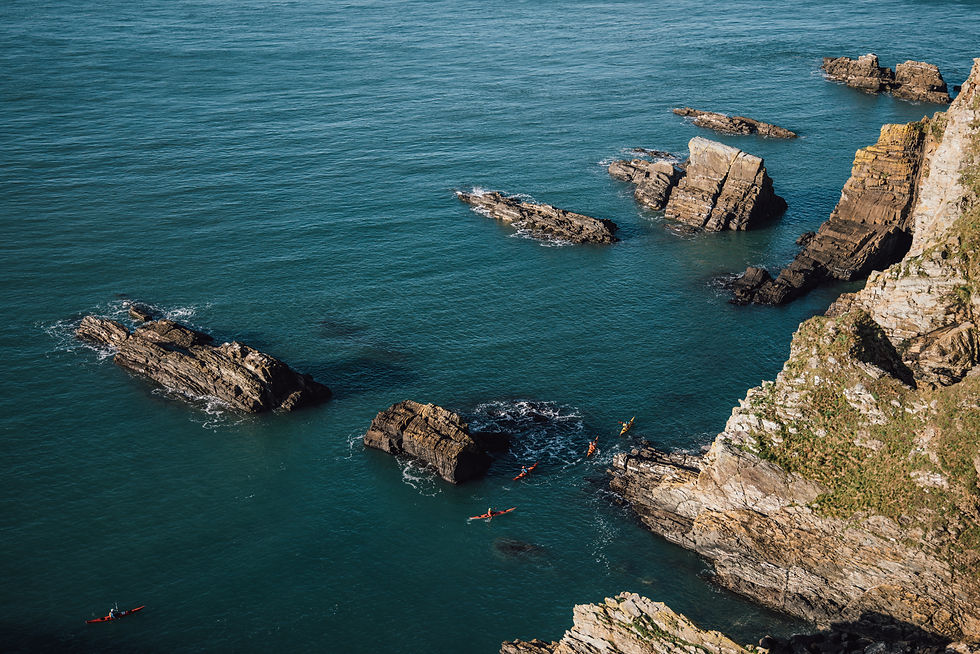
Further west, we ventured toward Castlemartin, an area of wild headlands that seems to belong to another world. Here, at the Green Bridge of Wales, the cliffs are sculpted into fantastical shapes by the relentless power of the sea. The Green Bridge itself is a vast limestone arch, a natural monument that rises proudly above the foaming water. Standing atop it, you can feel the wind tug at your hair and the earth hum beneath your feet. Just a short walk away are the Stack Rocks and the twin Elegug Stacks, named for the guillemots (elegug in Welsh) that nest there in their thousands. The air thrums with wings and cries as seabirds wheel in dizzying patterns. Watching them plunge into the sea from those towering stacks was hypnotic: a dance older than history itself.
After days spent exploring the coastal wilds, we longed for warmth and rest, and found both at the Stackpole Inn, a few miles inland. The inn sits in the heart of the tiny village of Stackpole, surrounded by rolling farmland and ancient woodland. Its whitewashed walls and slate roof give it an unassuming charm, but inside, the atmosphere is instantly welcoming. Low beams, soft lamplight, and a crackling fire greeted us like an old friend.
Our room overlooked the garden, where birds sang in the morning mist. Evenings were spent downstairs in the bar, sipping local ales and dining on hearty Pembrokeshire fare—line-caught sea bass, lamb from nearby farms, and sticky toffee pudding rich with Welsh cream. The inn’s owners have created something special here: a place that feels both luxurious and entirely unpretentious.
From this cozy base, we spent two days exploring some of Pembrokeshire’s most evocative landmarks. St Govan’s Chapel was our first stop: a tiny stone church wedged into a cleft of cliff, accessible by a steep flight of steps that seem to descend into the past. Legend tells that St Govan was a hermit who lived here in the sixth century, hiding from pirates in the crack that miraculously opened to shelter him. The chapel that now bears his name feels timeless. Inside, its single stone altar and narrow windows frame the sea below, the sound of waves echoing like a psalm. It is impossible not to feel the presence of history and of something even older, more elemental.
From there, we wandered the tranquil paths around Bosherston Lily Ponds, an oasis of stillness in contrast to the cliffs’ raw power. The ponds stretch over three lakes connected by causeways, fringed by reeds and shaded by ancient trees. In summer, the surface is carpeted with white lilies, their reflections shimmering in the water. Swans glide silently past, and dragonflies dart in flashes of iridescent blue. Following the path all the way to Broad Haven South Beach, we emerged onto a vast sweep of sand framed by limestone cliffs. The sound of the waves was like applause.

On our final day, we visited Carew Castle, a majestic ruin overlooking a serene millpond. The castle’s history spans more than two thousand years, from a Norman fortress to an Elizabethan manor and its walls hold echoes of every age. Reflections of the castle shimmered in the water as we wandered its halls, imagining knights, courtiers, and ghosts that might still linger. Nearby, the tidal mill one of the only working ones of its kind stood as a quiet reminder of Wales’s ingenuity and endurance, unfortunately due to bad weather, the path was closed to the public but the mill was easily visible from the castle.
By the time we returned to Saundersfoot, the sun was sinking low over the bay, painting the sea with streaks of silver and rose. Pembrokeshire had given us something rare: a perfect balance between wilderness and comfort, solitude and connection. Each moment felt deeply grounded but rooted in stone, sea, and story.
This corner of Wales is not simply a place to visit; it is a place to feel. From the soothing luxury of St Brides Spa Hotel to the warm embrace of the Stackpole Inn, from cathedral-like cliffs to lily-dotted lakes, Pembrokeshire invites you to slow down, breathe deeply, and let the landscape remind you of what truly matters.
Words by Sal F. and photos supplied by Visit Wales
A Big Thank you to Visit Wales, St Brides Spa Hotel and Stackpole Inn for making this happen.


