Lesser Spotted Barcelona and Beyond: The Alternative Catalonia Weekender
Barcelona rarely needs introduction. Gaudí’s spires, nights at the Camp Nou, the slow theatre of life on shaded plazas, it sells itself. But Catalonia as a region rewards those who step half a street, or one train stop, beyond the obvious.
This is a three-day weekender for travellers who like their cities with a bit more variety: less queueing, more wandering. Spend your first day in alternative Barcelona (not the one everyone sees) and then, using the city as a base, let the – fast, efficient, good value - trains carry you outward.
Day 1 – Barcelona Beyond The Tourist Traps
All good adventures start with breakfast. So do it properly.
The churros at Xurreria Sant Antoni, a 15-minute ride on Metro L2 (Sant Antoni) are the best in the city. This blink-and-you’ll-miss-it institution serves them crisp and golden, alongside thick, unapologetically rich hot chocolate. Catalan dominates the menu and the room. Truthfully, you don’t need to spend too long perusing – just order prims (thin) or gossos (thick) with the accompanying hot chocolate and accept that your weekly sugar allowance ends here.

Back in the centre, while most visitors funnel toward La Boqueria and the Gothic Quarter, drift east to El Born (Metro L4, Jaume I). Parallel to the Gothic Quarter but noticeably calmer, it feels like Barcelona exhaling, with cobbled alleys, independent boutiques, wine bars where someone is always pretending to read poetry while discreetly people-watching.
Close by is Santa Maria del Mar, my favourite church in the whole city. Built in the 14th century by local merchants rather than royalty or bishops, it remains one of Europe’s rare genuinely people-funded churches, rather than opulent symbols of Catholic excess. Its vast columns and restrained Gothic lines create a hush that can be very welcome after dodging the crowds elsewhere in the city.
Before closing time at 15:30, call into Mercat de Santa Caterina nearby. Beneath its undulating mosaic roof lies the produce market La Boqueria used to be: Iberian ham, Manchego, olives, sun-dried tomatoes, crusty bread. If you’re still craving sweet things after your churros, add turrón (nougat) or coca de llardons (flaky Catalan pastries with pine nuts).
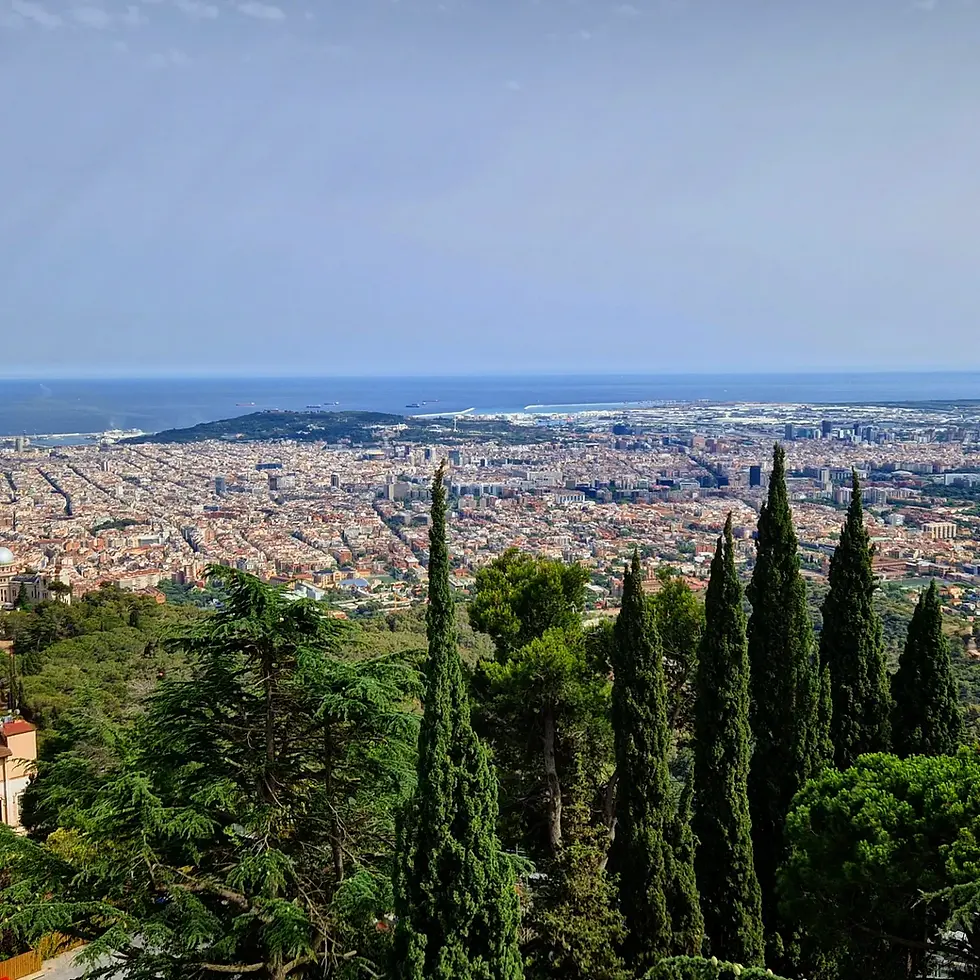
For the optimum sunset view, pick up some cold beers from a corner shop and head uphill to the Bunkers del Carmel (Metro L5, El Carmel, followed by a 10-minute walk uphill). Former anti-aircraft batteries from the Spanish Civil War now deliver the city’s finest free view: a 360-degree sweep from the – finally finished - Sagrada Família to the Mediterranean. Go before the city decides to start charging!

For my tuppence worth, evenings in Barcelona belong to El Raval. Once shorthand for “avoid after dark,” it is now host to intriguing venues, live music and locals drifting effortlessly between bars. At Two Schmucks (Carrer de Joaquín Costa 52), consistently ranked among the world’s best bars, cocktails are inventive and tasty without veering into pretension. A few doors down, Casa Almirall (Carrer de Joaquín Costa 33, est. 1860) specialises in absinthe. One glass is cultural curiosity. Two is research. Any more and you can write off Days 2 and 3 of this itinerary.
Day 2 – Montserrat, Catalonia’s Holy Mountain
An hour from Barcelona rises Montserrat, a serrated mountain range that looks geologically improbable and hiding a monastery that looks like the start of an epic Iberian fairytale.
From Plaça d’Espanya (Metro L1 or L3), buy the combined train-and-ascent ticket. Total journey time: roughly 90 minutes. Choose your climb: the cable car (Aeri) for drama, or the rack railway (Cremallera) for steadier views. Decide before purchasing, they serve different stations (I’d go with the cremalla, purely because it’ll be the first station on your return and you won’t be standing for an hour).

At the summit stands Santa Maria de Montserrat Abbey, home to La Moreneta, the Black Madonna, Catalonia’s most venerated religious icon. Basilica entry and Madonna access require timed tickets separate from the train/ascent; book ahead on the Montserrat Monastery website.
Tour groups multiply after 10.30am so if you swerved the absinthe last night, arrive early. Eating options at Montserrat are fairly uninspiring so picking up some picnic supplies from your market visit on Day 1 is never a bad plan.
The hills around Montserrat are ripe for exploration – and lunch al fresco - and a series of funiculars (charges vary) lift and drop you to various trailheads. For air and altitude, take the Sant Joan funicular and hike toward Sant Jeroni (about 90 minutes each way, moderate difficulty), the mountain’s highest point at an impressive 1,236m. Non-hikers can also use the funicular to access expansive views and escape the crowds without committing to a full trek.
Plan your descent around cremellera or cable car schedules (check on arrival as they change frequently). Towards the end of the day, queues form and capacity is limited. Standing in the baking sun tests the romanticism of any destination!
Day 3 – From Mountains To The Sea
Day 3 takes in two of my favourite spots in the region along the sprawling Costa Dorada south of Barcelona.

Trains from Barcelona Sants (Metro L5, Plaça de Sants, book tickets in advance here) run frequently along the coast. Avoid driving; Sitges parking, particularly in summer, is a competitive sport. Which you will lose.
First stop: Sitges (35 minutes). Known internationally for its queer-friendly culture and Pride festival, whose parade is refreshingly limited to local businesses and community groups, it balances celebration with an environment that remains authenticity Catalan.
The old town is a delight, its whitewashed lanes opening onto more seventeen beaches ranging from family-friendly (Platja Fragata) to nudist (Platja d'Aiguadolç) to proudly gay (Platja de la Radona), all within a 15 minute walk of the centre of town. The promenade is lined with restaurants and wine bars where morning coffee effortlessly becomes early vermouth...other tipples are available. The architecture of the central square (Placa del Cap de la Vila) also pays homage to the Catalan modernist tradition, unique to the region.
If you resist the temptation to stay and people watch on Placa de la Industria) where gay bars cluster, continue 40–50 minutes south to Tarragona.
Once Roman Tarraco, it remains layered with antiquity and is a surprising interesting counterpoint to Catalonia’s 20th century architecture. The Roman aqueduct Les Ferreres (a short bus ride with buses 5 or 85 from the city centre) stands remarkably intact to the extent you can walk both across and around it. Closer to the city centre, a seafront amphitheatre, Roman walls and a partially preserved circus completes the history lesson and the potential to channel your inner Ben Hur. You can still get the epic ocean views though - at the Balcó del Mediterrani, the coastline stretches wide and sunlit.

The other reason to linger in Tarragona is the food. This is a city that understands the sea. Order arros negre (squid-ink rice), cassola de romesco (white fish in red pepper-almond sauce) or arrosejat (rice or noodles cooked in a rich fish broth) washed down with Penedes, the local white wine.
From here it’s an easy hour-long train back to Barcelona, where you can continue your evening. Just steer clear of the absinthe tonight if you’re planning to get home!
Article by Guest Writer, Phil Thomas - Author of Someone Else's Country


