Baabybelles Box Office: Obsession
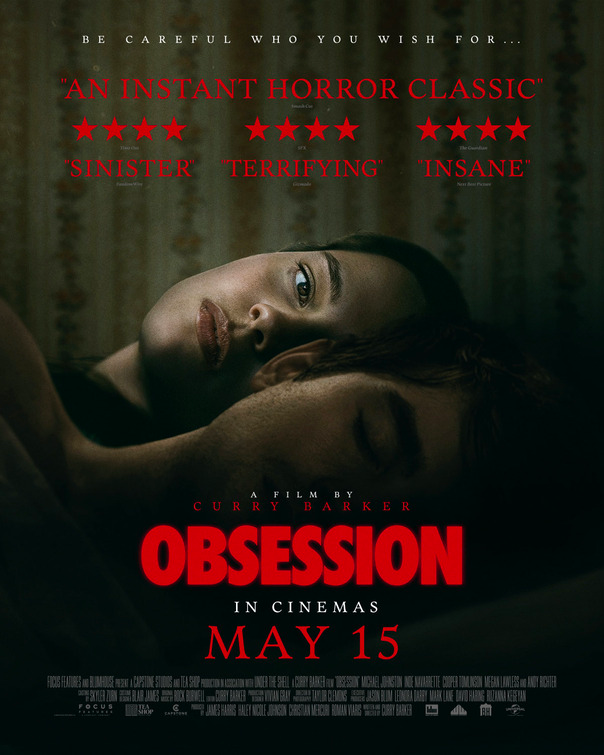
Obsession: ★ ★ ★ ★ ☆
June 2026
Directed by Curry Barker
One thing to know about me and something I’m sure you’ll all grow to learn: I’m a huge horror fan. Whether that be slashers, thrillers, or films led entirely by suspense with those ever-present feelings of dread, they’re all totally exhilarating to me. With that being said, you can only imagine my excitement for what seems to be an unofficial ‘summerween’ with the releases of Backrooms, Evil Dead Burn, and, as we’ll be diving into today, Curry Barker’s directorial debut: Obsession.
What got me the most about this film is how I genuinely couldn’t stop thinking about it for days after the fact. This is the kind of movie that sticks with you; the kind of movie that leaves you glued to your seat in complete disbelief as the credits roll, waiting for your heartbeat to regulate. Obsession isn’t a mindless horror film, nor one to watch lightly. It comes with loud, unapologetic purpose, asking questions of morality and demanding critical thought from its audience.
Honing in on distorted familiarity with a relatively simple concept, we follow Bear and Nicky on a twisted take of a tale as old as time: boy likes girl, boy pursues girl, boy gets girl. Obsession operates on a much smarter level than its premise suggests, playing to its strengths and embracing everything a modern horror should: tension, jump scares, gore and most importantly, emotional resonance. Hyperbolically exploring real-world interpersonal fractures, the film focuses heavily on deep-seated human emotions, using thematic metaphors and ‘supernatural’-esque elements to create a physical manifestation of real societal issues. The terror of this film doesn’t rely on monsters or mystery; it relies on the excruciatingly prolonged psychological tension that runs from start to finish.
Obsession takes its audience into a world grounded deeply in the reality of modern dating culture, bypassing the fundamental stages of evolving vulnerability and instead jumping immediately into sexual gratification and self-imposed emotional mania. Barker creates an environment that makes the horror feel personal, where the characters’ decisions leave the audience painfully aware of the danger to come, yet completely powerless to stop it.
What’s particularly interesting about the character narratives throughout this film is how Barker has gone completely against the grain by writing our protagonist as fundamentally unlikeable, incorrigible, and someone we're actively rooting against; Bear is the very definition of the ‘what happens when you give the nice guy a chance’ joke. Despite his seemingly genuine feelings for Nicky that initially instigates our sympathy, those feelings are ultimately nothing more than projections of who he wants her to be rather than a yearning or appreciation of who she is as an independently complex person.
Bear wishes for Nicky to ‘love him more than anything in the world’, but not because it’s the only way they could be together; in reality, the two already share a genuine, long-standing connection that could’ve plausibly developed into something deeper. Instead, he makes the wish because he’s fundamentally unwilling to risk the vulnerability, uncertainty and potential rejection that real intimacy demands. Bear appears oblivious to the consequences of his wish initially, seemingly unaware that it completely strips Nicky of her autonomy entirely. That ignorance, however, only excuses him for so long. Once it becomes painfully obvious that Nicky is a mere vessel for his desire and that her love is completely fabricated, Bear still chooses to indulge in the fantasy purely because it benefits him. He never seeks help nor attempts to solve the situation; even when Nicky briefly breaks through whatever force that controls her, desperately begging him to kill her, he refuses. This is what becomes the film’s moral breaking point. His obsession isn’t simply about wanting Nicky; it’s about possessing a version of her completely incapable of choosing anyone else.
Obsession seamlessly accumulates every familiar horror trope and blends them into one relentlessly anxiety-inducing cinematic experience. I left the cinema completely shaken, unsure exactly what I'd watched or why it had affected me so profoundly. Barker has crafted a horror film that is terrifying enough to provoke audible screams in theatres, yet somehow even more terrifying once you unpack its subtext. Beneath its basic premise lies a story of autonomy, free will, morality, toxic masculinity and the dangerous entitlement that can grow from unreciprocated desire. It challenges our perceptions of friendship, love and the people around us, forcing us to question where affection ends, and possession begins. It’s an exaggerated version of what many women will experience, or have experienced, at some point in their lives: relentless pursuit from someone unwilling to accept "no" as an answer.
The horror in Obsession doesn't come from the wish itself; the film makes it clear that the wish grants exactly what's asked of it. The real horror comes from what Bear chooses to wish for, what that represents and how frighteningly recognisable it is; it’s the entitlement and possessiveness that can exist beneath the surface of seemingly ordinary men. That's what makes Obsession so unsettling, and what makes it one of the best horror films I've seen in years.
If only the first twenty minutes of dialogue were slightly better, we would’ve had a 5* film on our hands.
By Bella Proudfoot


